For those of you who haven't already seen them, these videos appeared on YouTube recently. It's a half hour TV documentary from the 1960s narrated by John Betjeman. Just superb!
Showing posts with label prototype. Show all posts
Showing posts with label prototype. Show all posts
Sunday, 18 May 2008


Thursday, 31 January 2008
The perfect prototype... continued
Just did some back-of-an-envelope calculations based on a Google maps aerial photo and in 4mm scale the entire station area would fit into an area no bigger than 2'6" x 11'6"!
The perfect prototype
I've just discovered what must be the most perfect prototype for a small model railway ever to exist - Bodmin General. Having never visited the preserved Bodmin & Wenford Railway I've not had a chance to see this charming little station for myself, but the latest edition of the Great Western Railway Journal contains a fascinating article looking at the history of the line from Bodmin Road to Padstow, with a number of tantalising photographs.
It's the photographs and details of Bodmin General, the GWR's Bodmin terminus that caught my attention almost immediately. Here is a station that has it all: a branch line terminus on an extremely compact site with a road underbridge conveniently positioned at the station throat, a single road engine shed that was operational into the early 60s, a goods yard consisting of 2 sidings (opposite to and parallel with the station platform) and a small goods shed, a junction - within the confines of the station area itself - leading to the Southern Region operated line from Bodmin (North) to Wadebridge and Padstow, with trains from both regions using Bodmin General, and, to cap it all it still exists!
Given the similarities with the various layout plans I've come up with already, it's a tempting proposition to go all out and model Bodmin General to the letter, but I probably won't as I prefer the freedom to use my imagination a little bit more rather than being tied to an exact prototype. However, as a basis at least for a layout plan - particularly with the additional branch and combined workings - it's a very useful prototype to be able to refer to.
A modern photo of the station area can be found here: http://www.steampics.com/html/bwr040.html
This is taken from the road bridge at the throat of the station with the branch to Wadebridge leading off to the left. The goods shed has gone unfortunately as has the original engine shed (the new one can be seen on the left) but it gives an idea of the extremely compact nature of the site. I've not measured it up on a map, but I guess in 4mm the whole station would fit, with very little reduction in scale, into an area not much more than 12'x2'!
Monday, 16 July 2007
The question of location
There's still one pretty fundamental aspect of the layout that remains undecided and which needs to be resolved rather quickly. In fact, until it's been decided I can't even start on the trackwork....
It's just the small matter of location!
I can't seem to come to a final decision about where exactly I want to model. There are several prototype scenarios that appeal, most of which I've already written about at one time or another.
Although the exact location of the model is going to be fictional, I still need to have a fairly good idea of location - and region. My first allegiance has always been to the WR. However, the SR also appeals, and to a lesser extent the LMR. The obvious conclusion of this would be the S&D with it's joint railway status seeing locomotives and rolling stock from all three of these regions. However, the thing that slightly puts me off is the difficulty in coming up with a convincing enough scenario for a branch terminus without blatantly copying Chris Nevard's 'Combwich'! Maybe I'm not being imaginative enough but I'm just not sure.
I've already toyed with the idea of basing a layout on Llanfyllin in mid-Wales, but this layout is just too small to get away with a convincing interpretation, even acounting for modellers license.
Then there's the Bude line, and the Southern branches around Hampshire and Dorset...
Even if I don't quite pin it down exactly yet, I really do need to decide whether or not the line is in ex-GWR territory as this will determine the type of chairs used on the track. But I'm not even really sure about this!
HELP!!!!
Sunday, 10 June 2007
Great Central Railway photos
I've added a few photos to Flickr taken on a flying visit to Quorn & Woodhouse station on the Great Central Railway yesterday.
Monday, 23 April 2007
New Photos on Flickr!
It's not model-related, I know, but I've just uploaded a bunch of new photos taken at the Severn Valley Railway on Saturday (with my new camera!) to my Flickr photo site.
Saturday, 25 November 2006
The Bude Line
In the November and December issues of Back Track magazine there's been a 2-part feature on the now closed Okehampton-Bude branch which I've found particularly interetsing and inspiring. One of the reaons I was initially interested was that we spent a week in Holsworthy this summer, so a number of the locations are still fresh in my memory, including the site of Holsworthy station which we visited due to its having recently become a supermarket car park!
Sometimes a particular photo just leaps out at me and captures my imagination and that's what happened with the photo at the top of page 748 in the December issue (the page numbering continues through from January to December!). It shows a view across the tracks to the platform at Bude on a wet and overcast summer afternoon in 1964 with a grimy N Class simmering in the sidings while an equally grimy BR Standard Class '4' tank prepares to depart with a short passenger train.
As is often the case, I can't put my finger on what it is in particular that captures my imagination so much about this photo but it absolutely reeks of atmosphere - you can almost feel the drizzle, smell the steam, and hear the seagulls and hissing valves.
It's these occasional moments of inspiration that fuel my creative energy, and while an actual layout is still some way off being built yet, I'm continually collecting together a mental scrapbook of images that will hopefully eventually come together into a model.
powered by performancing firefox
Wednesday, 27 September 2006
Dr Beeching's Bitter Pill
Interesting article from Time magazine in 1962:
http://www.time.com/time/magazine/article/0,9171,896027,00.html
Considering the title of this blog, I was interested by the sub-title 'Nowhere to Nowhere' half way down the page.
Sunday, 6 August 2006
Catching up
Well, it's been some time since I last posted. In the meantime we've moved in to the new house, been on holiday and generally been busy with all the things there are to do when you move house!
While we were on holiday (or should I say, while we were on our way) I managed to persuade Becky to take a bit of a detour between junctions 22 and 23 of the M5 so we could stop off at a couple of locations on the route of the Somerset & Dorset Railway Highbridge branch.
First we stopped at Bason Bridge then Edington Junction. At Bason Bridge apparently the old platform still survives in the undergrowth alongside a farm track but there's nothing visible. At Edington the station house and station hotel still survive as does part of the old platform apparently although it's on private property so I couldn't see it.
The most interesting thing really was to see and get a feel for the countryside, so much a key characteristic of the branch with the flat Somerset levels stretching away towards the hazy outlines of distant hills on the horizon.
Back at home I made a rather unhappy discovery - the garage walls leak! This will clearly require some work to waterproof things - I'm waiting for a freidn who is a building surveyor to come and advise! It could be a little while yet before I'm in any position to start building the model railway!
Finally, I've been giving some thought as to the supposed real-life location of the planned model. Initially I hadn't been too bothered about this, being happy for it to be a purely fictional location based on the S&D branch. However, having an actual location in mind allows you to connect your piece of fiction with what really was. The less hurdles you have to jump towards believability the better in my opinion.
OK, some might argue that I should go the whole hog and simply create a true-to-life model of an actual location. For some this might be the way to go, but for me this doesn't allow enough flexibility. To me, a model railway should still allow you to use your imagination, even if each individual aspect is based on a particular prototype. After all, this is how the imagination works - by taking various elements from different places and combining them into something new. Even our memories of places and events are often selective - combining the best bits and discarding others to create what is often a rose-tinted view of the past. I think this has a lot of parallels with modelling.
Anyway, it's proving tricky to find a location. Anywhere worth having a railway connection already had one at some stage in the past, so looking at a map of the area there really aren't any obvious places just crying out for a branch line terminus! Currently I'm confining my search to the Somerset levels because I like the idea of modelling this landscape simply because it is so distinctive. (The drawback is that it's not so easy to hide things when there are no hills!)
The only possibilities so far seem to be North Petherton (just on the edge of the Quantocks south of Bridgwater) - the possible scenario being an extension of the Bridgwater railway south towards Taunton which ran out of steam (so to speak) due to finiancial difficulties and the construction of the GWR line. Or Cannington - north west of Bridgwater, also just on the edge of the Quantocks. I'm aware that this is just adjacent to Combwich, and Chris Nevard has already constructed a good pseudo-history for his model to here, so I don't want to steal his thunder!
Another alternative is to find a location where no settlement exists (or perhaps where there is a farm or small hamlet) and propose that this grew into a decent sized village or small town during the late 19th century. But again - where?
Sunday, 4 June 2006
Branch goods operation
Found a very useful little snippet of information while reading an article by Ian Rice in Model Railway Journal issue 39:
Also, it is feasible that if there were an industrial facility (or more than one) served by the railway somewhere beyond the scenic break of the layout, trains destined for there might well run into the terminus first in order for the loco to run round so that the train is the 'right' way for accessing/shunting the sidings. This provides an excuse to run more than just those trains destined for the terminus itself. Some thought of course needs to go into what rail-served facilities there might be in the vicinity that would necessitate such workings...
"On branches, the intermediate goods yards are, perforce, laid out to be shunted in one direction only - indeed, a great many branches have all the goods sidings liad out for shunting from the same end, very often the juntion end. The corrrect modus operandi was to run the branch goods direct to the terminus, run round there, shunt the terminus, and then shunt the intermediate stations on the way back to the junction."The reason I find that so interesting is because it casts a little more light on prototypical goods operations. Goods trains entering the terminus, according to this procedure, would consist of all the wagons destined for all the stations along the branch, not just those left over after all the intermediate stations have been served. After shunting the yard, the departing train would include both empties from the terminus and loaded wagons for the other stations.
Also, it is feasible that if there were an industrial facility (or more than one) served by the railway somewhere beyond the scenic break of the layout, trains destined for there might well run into the terminus first in order for the loco to run round so that the train is the 'right' way for accessing/shunting the sidings. This provides an excuse to run more than just those trains destined for the terminus itself. Some thought of course needs to go into what rail-served facilities there might be in the vicinity that would necessitate such workings...
Tuesday, 31 January 2006
Goods
There's an interesting section in the EM Gauge Society manual looking at prototypical railway goods handling in the 1950s. I read it with interest as I'm keen to find out as much as possible about prototype operating practise - both to inform the way I construct the model and also, later, the way I operate it.
Currently my plan, as the track plan shows, is to have a simple two-road goods yard adjacent to the station platform. My initial thoughts were that I would incorporate a goods shed, some coal stacks, and a cattle dock, with a yard crane for general unloading. The question is where to position these things in a way that allows for prototypically correct operation.
I had sketched in on my plans to have the coal stacks adjacent to the goods shed road, but I'm wondering how realistic this is - I don't know how long coal wagons would be left here for unloading comparative to vans in the goods shed, or on the other hand whether goods sheds were still used for unloading of railway vehicles by this stage?
Is the positioning of the cattle dock adjacent to the loop spur a realistic location? I have seen similar positionings on prototype track plans of terminus stations. Were cattle still being transported by rail in the 50s/60s?
Basically, there are a lot of details I still need to find out about before I start attacking the model. One thing I am aware of is that the yard sidings need to be spaced far enough apart to allow vehicle access between them for loading and unloading. I need to take this into account when laying the track.
I'm also still concerned that the goods yard may look a little cramped as laid out on the track plan. Ideally I'd like the yard entrance to be moved further back along the approach line, but this also means pushing back the engine shed, and so on, which encroaches on the second basebaord, means more tracks crossing the baseboard join, and also reduces the perceived lenth of running line from the fiddle yard to the station throat. I know it's got to be a compromise - I don't want the entire layout to just be station without any 'run-in' but at the same time I don't want things to look artificially cramped. (Mind you, compared to the initial ideas I had of squeezing all this onto a 12" wide baseboard this is already spacious!!)
Monday, 16 January 2006
Somerset & Dorset inspiration
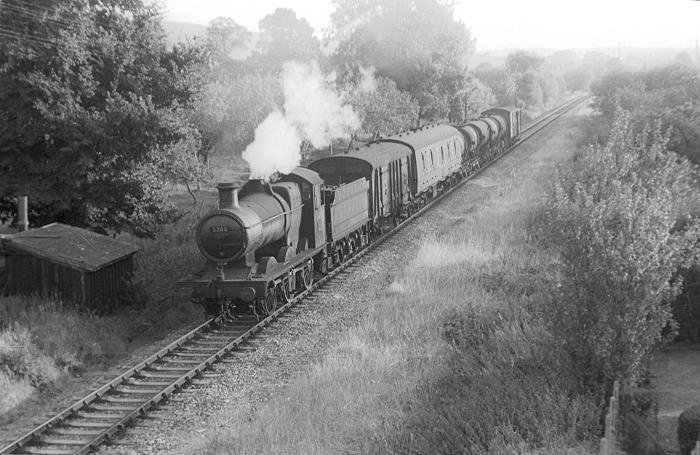 Having already found plenty of inspiration in Chris Nevard's Combwich model (and unashamedly based my layout plan on his, given the similarity in layout dimensions and general prototype era), yesterday afternoonI found myself following web links about the Somerset and Dorset Railway and happened across 3218.co.uk where there is an absolutely superb collection of black & white photos of the last days of steam on the S&D.
There's something incredibly evocative about these images of trains ambling across the Someset levels.
While I don't intend to stick strictly to any exact prototype location with my model, these photos along with the Combwich model have fuelled my imagination enough that I think I'm going to base my model at least loosely on the S&D - albeit a fictional section of line and location and probably with a few items of rolling stock that wouldn't have appeared on the S&D itself.
(Photo copyright Ian D. McKechnie - http://www.3218.co.uk)
Monday, 2 January 2006
Thoughts on prototype operation
One of the things I'm keen to do from the outset is ensure that everything fits reasonably well with prototypical railway practise for the period and location I'm modelling (actually, my current idea is to keep these reasonably broad - rural location jointly operated by the Western and Midland regions, around the 1950s/early 60s... I may get more specific as things develop!), at least to the extent that it satisfies my own desire for realism if not always being strictly accurate down to the last detail. The extent to which you take this is obviously a matter of personal choice.
In coming up with a track plan one of my concerns has been operational realism as well as interest. For example,I knew it was essential from the outset to include a run-around loop on the main platform road so that passenger trains could be pulled into and out of the station. However, I wasn't so sure about the procedure for goods trains. And what about passenger trains using the second platform which doesn't have a run-around loop (a problem of my own making - I wanted a second platform to allow for a little more interest both visually and operationally and already knew from looking at a number of prototype station plans that run-around loops where not provided for all platforms)?
Chris Nevard, creator of Combwich, helpfully provided the information I needed: "All trains coming in would have come into the main platform line, the engine would then run around its train, pull it out again then push into the sidings - this would be the same for the platform without a loop. Lines like this in real life would have only had a few trains a day."
Subscribe to:
Posts (Atom)